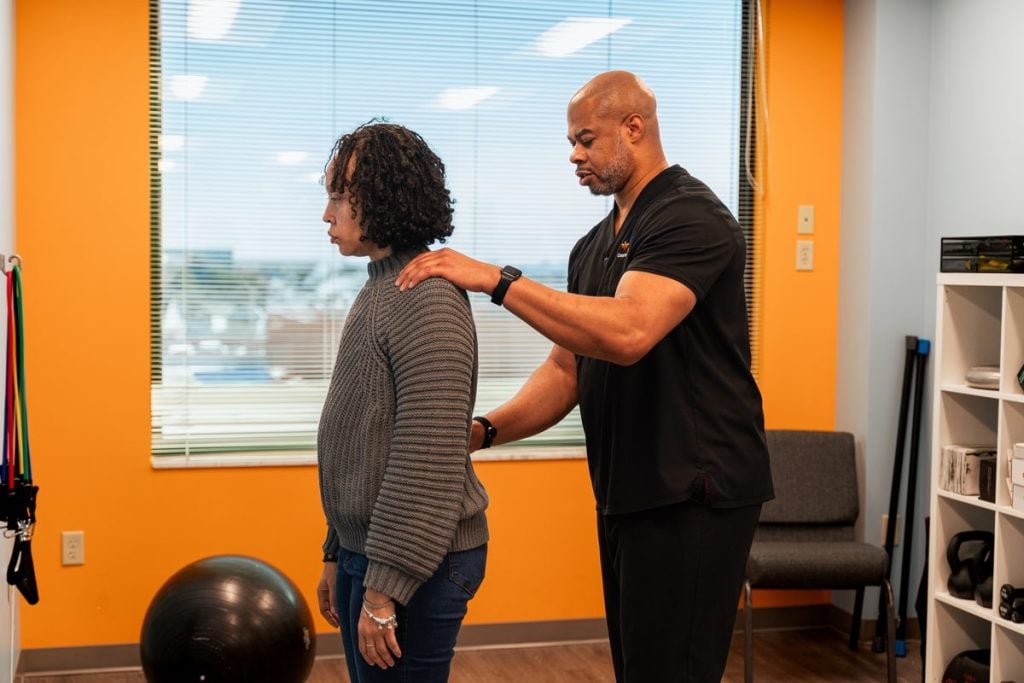
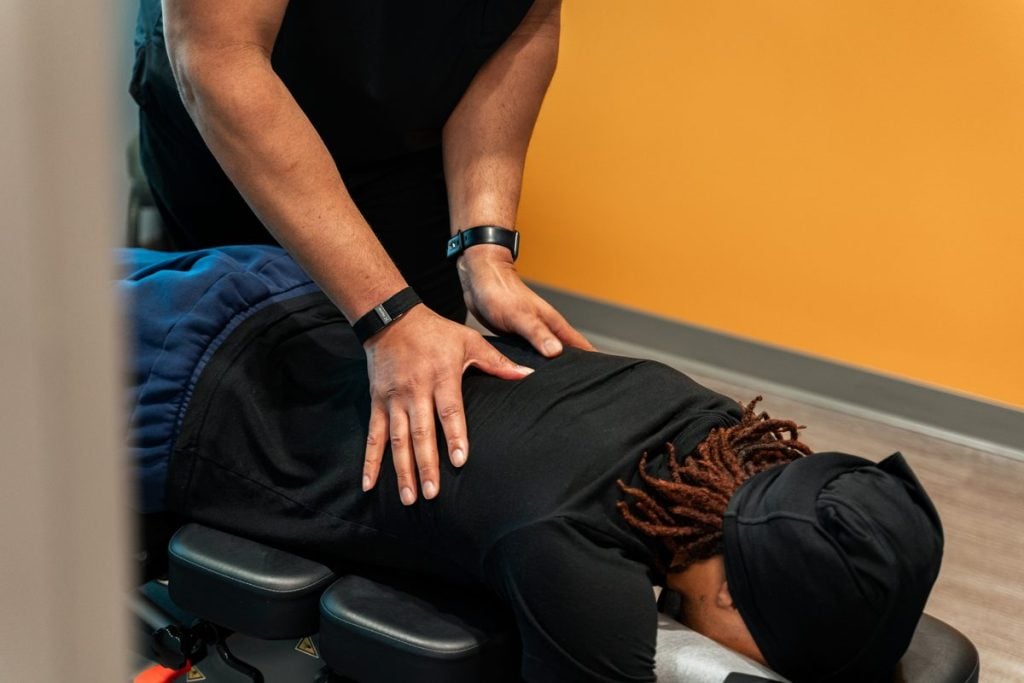
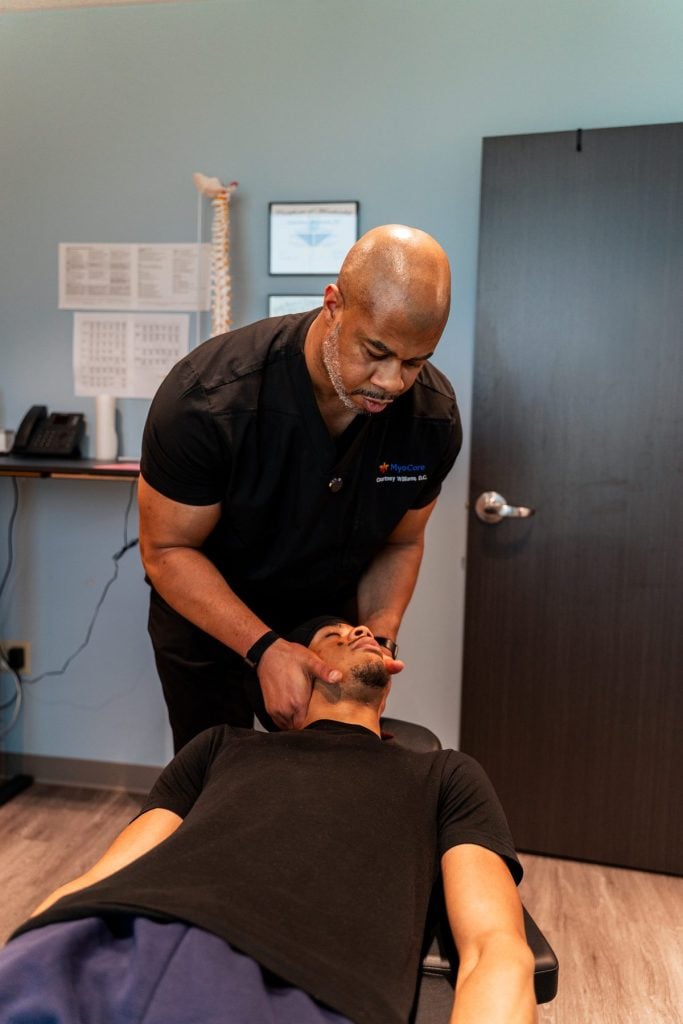
Myofascial Release Therapy, instrument-assisted soft-tissue mobilization, and targeted myofascial work — because adjustments don’t hold when the muscles around them are locked down.
Plain-English on what’s actually going on — so the treatment plan makes sense before you commit to it.
Why muscles get and stay tight
Repetitive motion (sitting, typing, training one pattern) shortens the working muscle and weakens its opposite. The shortened muscle starts protecting the joint by pulling on it constantly. That guarding is what you feel as a ‘knot’, it’s a muscle that has forgotten how to relax because the brain has decided it’s safer to hold tension than to let go.
Why a percussion gun isn’t enough
Vibration and pressure can quiet the symptom for an hour or two by overriding the pain signal, but they don’t change the protective pattern that put the muscle in guard mode. Restoring the joint underneath, then re-teaching the muscle to lengthen under load, is what makes the change stick.
What we do about it
Three things, in this order.
No 36-visit packages. No mystery techniques. Just the part that actually changes the picture.
01
Trace the chain
Most ‘low back tightness’ starts higher (lat) or lower (glute, hip flexor). We palpate along the kinetic chain to find where the tension actually originates.
02
Active Release pass
Sustained pressure on the affected tissue while you actively move the joint through range. Specific, intense, fast.
03
Reload the pattern
Two or three eccentric or end-range drills that re-teach the muscle to lengthen and contract through its full range
What happens during a visit
No mystery. No surprises.
Every visit follows the same honest structure — assess, treat, plan. Here’s exactly what to expect.
01
Identify the restriction
We palpate the involved muscle and trace the line of tension to its source. Most ‘back pain’ is actually a chain; glute, lat, hip flexor, quadratus.
02
Active Release pass
Sustained pressure on the affected tissue while you actively move the joint through range. It’s intense but specific and it makes a measurable difference in one session.
03
IASTM where indicated
Stainless-steel instruments to break up adhesions in fascia and scar tissue, especially helpful for chronic tendinopathies and post-surgical restrictions.
04
Pair with movement homework
Soft-tissue work is half the picture, we send you home with the specific mobility drills that protect the gains.
From the library
See it explained, then read the deeper version.
Short videos from Dr. Williams and Dr. Wilson on this exact topic. Each one links to a full article so you can save or share it.
Don’t see what you’re dealing with? Call us — we’ll tell you honestly whether we can help or who to see instead.
Who this is for
A good fit if…
Pain that won't resolve with adjustments alone
Repetitive-strain injuries from work or sport
Athletes wanting active recovery
Common questions
The questions we hear most.
If yours isn’t here, just ask when you call, we don’t gatekeep information.
Does Myofascial Release Therapy hurt?
It’s strong but tolerable, most patients describe it as ‘good pain.’ We work at your tolerance and stop if anything feels wrong.
How long until I feel a difference?
Most patients notice change within 1–3 sessions for acute issues. Chronic conditions take longer but should show measurable progress within 4–6 visits.
 Franchise